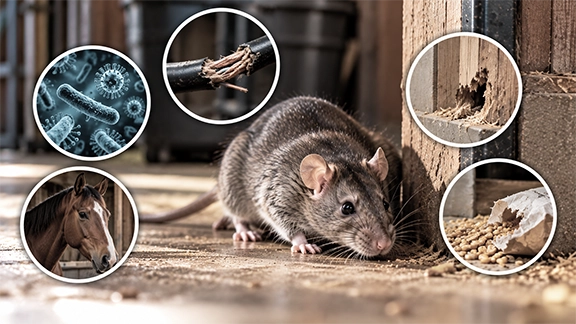
Rodents are more than a nuisance. Rats and mice can contaminate food and surfaces, damage buildings and electrical wiring, and expose people and animals to disease-causing organisms through droppings, urine, bites, parasites, and contaminated materials.
Understanding these rodent risks is important whether an infestation occurs in a home, business, horse barn, farm, or other property.
Wildlife Works provides professional rodent control throughout Central Florida, helping property owners identify rodent activity and address the conditions contributing to an infestation.
What Health Risks Are Associated With Rodents?
Rats and mice can carry pathogens capable of causing human disease. Exposure does not always require direct contact with a rodent.
Depending on the disease, transmission can occur through:
- Contact with rodent droppings or urine
- Contaminated food or surfaces
- Breathing contaminated particles from disturbed rodent waste
- Rodent bites or scratches
- Contact with contaminated nesting materials
- Fleas, ticks, or other parasites associated with rodents
The specific risk depends on the rodent species, pathogen, type of exposure, and surrounding environment.
What Diseases Can Rodents Spread?
Several rodent-borne diseases are recognized by public-health authorities in the United States.
Hantavirus:
Certain rodents can carry hantaviruses. People may become infected when virus-containing particles from rodent urine, droppings, or nesting materials become airborne and are inhaled.
Some hantaviruses can cause Hantavirus Pulmonary Syndrome (HPS), a serious respiratory illness.
Because of this risk, rodent droppings and nesting materials should not be swept or vacuumed while dry.
Leptospirosis:
Leptospirosis is a bacterial infection that can spread through the urine of infected animals, including rodents. People and animals may be exposed through contaminated water, soil, food, or surfaces.
Salmonellosis:
Rodents can contaminate food and food-preparation areas with bacteria, including Salmonella. Contamination may occur when food or surfaces come into contact with rodent droppings, urine, or other contaminated materials.
Rat-Bite Fever:
Rat-bite fever is a bacterial illness associated with contact with infected rodents. Despite its name, transmission does not always require a bite and may occur through scratches or contact with contaminated materials.
Lymphocytic Choriomeningitis Virus (LCMV):
LCMV is associated primarily with the common house mouse. Exposure can occur through contact with urine, droppings, saliva, or nesting materials from infected mice.
Are Rodent Droppings Dangerous?
Rodent droppings should be treated as potentially contaminated material.
Droppings are often one of the first signs of an infestation and may be found in cabinets, attics, garages, warehouses, feed rooms, storage areas, kitchens, barns, or other locations where rodents travel.
The greatest concern during cleanup is unnecessarily disturbing dried droppings, urine, or nesting materials and creating contaminated airborne particles.
How Should Rodent Droppings Be Cleaned Up?
The CDC recommends wet-cleaning rather than sweeping or vacuuming dry rodent waste.
Before cleanup, follow current CDC recommendations for ventilating the area when appropriate and wear rubber or plastic gloves. Droppings, urine, and contaminated materials should be thoroughly wetted with an appropriate disinfectant and cleaned according to CDC guidance and the disinfectant manufacturer’s instructions.
Heavy infestations may require additional protective equipment and cleanup precautions.
Can Rodents Contaminate Food?
Yes. Rats and mice may contaminate food, animal feed, food packaging, preparation surfaces, and storage areas with droppings, urine, hair, or other contaminated material.
Rodents can also gnaw through bags, boxes, and other packaging to reach food.
Food should be stored securely, and food products showing evidence of rodent contamination should not be consumed.
Can Rodents Bring Fleas and Other Pests Inside?
Rodents can carry fleas, ticks, mites, and other parasites. This means a rodent infestation can sometimes introduce additional pest concerns into a home, business, barn, or other building.
Controlling the rodents and addressing nesting areas can therefore be important parts of resolving the broader pest problem.
What Property Damage Can Rodents Cause?
Rats and mice have continuously growing incisors and gnaw on many different materials.
Rodent damage may include:
- Chewed electrical wiring
- Damaged insulation
- Holes in walls or building materials
- Damaged food and product packaging
- Contaminated stored materials
- Damage around pipes and utility areas
- Chewed plastic and other materials
- Damage to equipment or stored belongings
An infestation that remains undetected can allow this damage to become progressively more extensive.
Can Rodents Create a Fire Risk?
Rodents can create a fire hazard by damaging electrical wiring.
Rats and mice may chew through the protective insulation surrounding electrical wires. Damaged wiring can result in electrical problems and may increase the risk of fire.
Evidence of rodent activity near wiring, electrical equipment, attics, walls, or utility areas should therefore be taken seriously.
Rodent Risks for Horse Barns & Equine Facilities
Rodent problems deserve particular attention around horses because barns and equine facilities often provide abundant food, water, shelter, and nesting opportunities.
The risks apply to commercial equine centers, boarding and training facilities, breeding operations, and privately owned horse barns and farms.
Contaminated Horse Feed:
Grain, supplements, treats, and other horse feed can attract rats and mice. Rodents may chew through feed bags and contaminate feed or storage areas with droppings and urine.
Keeping horse feed in secure, rodent-resistant containers and promptly cleaning spilled grain can help reduce this risk.
Contamination Around Water and Feeding Areas:
Rodent urine and droppings may contaminate areas around feed rooms, stalls, water sources, storage spaces, and other parts of a barn.
Regular inspection and sanitation are particularly important where horses, barn staff, pets, and other animals share the environment.
Barn Fire Hazards:
Electrical damage can be especially concerning in barns.
Rodents may gnaw wiring associated with lighting, fans, outlets, equipment, water systems, and other electrical components. Combined with hay, bedding, wood, and other combustible materials commonly found in barns, damaged wiring creates a risk that should not be ignored.
Damage to Tack, Equipment and Supplies:
Rodents may nest in or damage saddle pads, blankets, stored supplies, boxes, insulation, and other materials kept in tack rooms and storage areas.
Feed rooms and less frequently disturbed storage spaces can also provide protected nesting areas.
Risks to Horses, People and Other Animals:
Rodents and contaminated environments may expose horses, barn staff, pets, livestock, and other animals to pathogens or parasites.
A comprehensive rodent-management program for an equine property should therefore consider more than simply removing visible rats or mice.
What Are the Risks of Rodents in Businesses?
Rodent infestations can create additional concerns for commercial properties.
Restaurants, commercial kitchens, warehouses, food-processing facilities, retail businesses, offices, and other commercial environments may face contaminated products, damaged inventory, electrical damage, sanitation concerns, and disruption to normal operations.
Visible evidence of rats or mice can also affect customer confidence in a business.
What Are the Risks of Rodents in Homes?
Inside homes, rats and mice may establish nests in attics, walls, garages, kitchens, cabinets, crawl spaces, and storage areas.
In addition to potential disease exposure, homeowners may encounter contaminated food, droppings and urine, damaged belongings, odors, and chewed electrical wiring.

When Does a Rodent Infestation Require Professional Attention?
Consider professional rodent control when:
- Droppings continue to appear
- Rats or mice are seen regularly
- Scratching or movement is heard inside walls or ceilings
- Food or animal feed is being contaminated
- Wiring or building materials are damaged
- Rodents are active in a barn or commercial facility
- Nesting areas are difficult to access
- The source of the infestation cannot be identified
- DIY control methods have not resolved the problem
- Rodent activity returns after previous treatment
The longer an infestation continues, the greater the opportunity for contamination and property damage.
Reducing Rodent Risks
Reducing rodent risks requires addressing both the animals and the conditions supporting the infestation.
A comprehensive approach may include inspection, removal or population control, sanitation, elimination of food and water sources, rodent exclusion, and ongoing monitoring.
Professional Rodent Control in Central Florida
Wildlife Works provides professional rodent control for homes, businesses, farms, horse barns, and equine facilities throughout Central Florida.
Our team looks beyond the visible rodent to identify signs of activity, nesting areas, entry points, food and water sources, and other conditions contributing to the infestation.
Addressing these factors helps reduce both the immediate problem and the risk of future rodent activity.
Concerned About the Risks of a Rodent Infestation?
If you’ve discovered rodent droppings, contaminated materials, damaged wiring, or other signs of rats or mice, Wildlife Works can inspect the property and recommend an appropriate solution.
Need Help?
Call Now: 352-717-8727
Don’t wait for wildlife or pest problems to escalate. Get expert help today.
Request Your Free Inspection.
Sources & Expert Review
Reviewed Against: CDC rodent-control and rodent-disease guidance; EPA Integrated Pest Management and rodent-control guidance; UF/IFAS Florida rodent-management guidance; and Wildlife Works’ Central Florida field experience.
Last Reviewed: September 2026
Next Review: September 2027, or sooner if authoritative guidance changes.