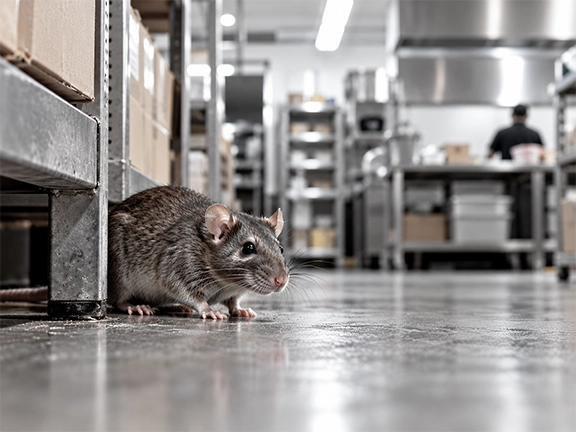
Rodents can create serious problems for businesses. Rats and mice can contaminate products, damage property and equipment, disrupt operations, and create sanitation concerns for employees and customers.
Effective rodent control for businesses requires more than responding to an occasional sighting. A commercial rodent-control program should identify rodent activity, address the existing infestation, locate potential entry points, reduce conditions that attract rodents, and provide long-term protection against future infestations.
Wildlife Works provides professional commercial rodent control services for businesses and commercial properties throughout Central Florida.
Why Are Rodents a Problem for Businesses?
Commercial properties can provide rodents with everything they need: food, water, shelter, and access to protected nesting areas. Warehouses, restaurants, commercial kitchens, offices, retail locations, storage facilities, and other businesses may also have multiple doors, utility penetrations, loading areas, and structural gaps that rodents can use to gain access.
Once inside, rats and mice may establish nesting areas behind walls, above ceilings, near stored products, or in other spaces where they can remain hidden.
What Damage Can Rodents Cause?
Property and Equipment Damage
Rats and mice gnaw frequently and can damage electrical wiring, insulation, walls, packaging, stored products, equipment, and building materials. Damage to electrical wiring may also increase the risk of equipment failure or fire.
Contamination and Health Risks
Rodents can contaminate surfaces, food, packaging, and stored products with droppings, urine, hair, and nesting materials. Rodents can also carry pathogens that may spread directly or indirectly to people.
Business and Operational Problems
A rodent infestation can interfere with normal operations and create concerns for employees and customers. Businesses that handle or store food may face additional sanitation and pest-management requirements.
Addressing rodent problems quickly can help protect the facility, inventory, employees, customers, and business reputation.
What Are the Signs of Rodent Activity?
Common signs of rodents in a commercial property include:
- Rodent droppings
- Gnaw marks
- Rub or smudge marks
- Damaged packaging
- Nests or nesting material
- Scratching sounds, particularly at night
- Urine stains or unusual odors
- Damaged electrical wiring
- Rodent sightings
- Evidence around stored products or food areas
Regular inspections can help identify signs of rodent activity early, before a small pest problem develops into a larger infestation.
Why Are Rodents Attracted to Commercial Properties?
Rodents are attracted to environments that provide reliable food, water, and shelter.
Food scraps, improperly stored products, garbage, standing water, leaking plumbing, clutter, vegetation, stored materials, and poorly maintained waste areas can create conducive conditions for rats and mice.
Commercial buildings may also provide numerous potential entry points because of frequent deliveries, exterior doors, loading areas, utility connections, plumbing, mechanical systems, and daily movement throughout the facility.
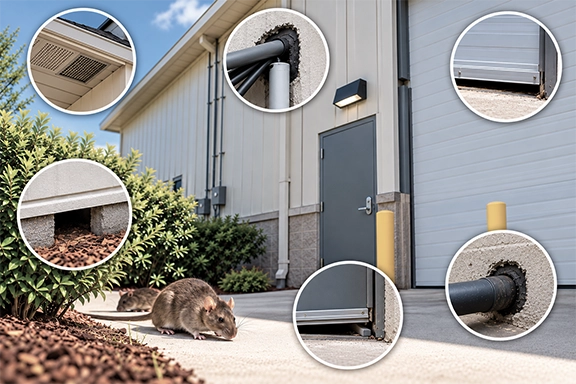
How Do Rodents Enter Commercial Buildings?
Rodents may gain access through:
- Gaps beneath exterior doors
- Loading and delivery areas
- Garage doors
- Damaged door sweeps
- Openings around pipes and utilities
- Rooflines and vents
- Structural gaps and cracks
- Damaged screens
- HVAC and mechanical penetrations
- Openings around foundations
These structural vulnerabilities can be particularly difficult to identify in large or complex facilities.
A thorough inspection should evaluate both the interior and exterior of the building to locate potential rodent entry points and evidence showing where rats or mice are active.
How Does Commercial Rodent Control Work?
1-Thorough Inspection
Effective commercial rodent control begins with an inspection of the facility and surrounding property.
Wildlife Works looks for droppings, gnaw marks, rub marks, nesting areas, food and water sources, rodent travel routes, structural gaps, and other evidence of rodent activity.
2-Identify the Rodent Problem
Correctly identifying whether the facility has rats, mice, or another rodent problem helps determine appropriate control methods.
The inspection also helps establish where rodents are active and what environmental conditions may be supporting the infestation.
3-Develop a Tailored Treatment Plan
Commercial facilities have different layouts, operating schedules, sanitation requirements, customer areas, and pest risks.
An effective treatment plan should consider the specific needs of the business, including the extent of the infestation, facility operations, food or product storage, employee and customer activity, and potential access by non-target animals.
4-Rodent Control and Removal
Professional rodent removal may include traps, bait stations, or other appropriate control methods.
Placement should be based on evidence of rodent activity rather than simply placing traps throughout the building. Control methods should also account for the way employees, customers, equipment, and products move through the facility.
5-Rodent Exclusion
Rodent exclusion involves identifying and sealing potential entry points that allow rats and mice to enter a building.
Depending on the structure, exclusion may involve door sweeps, metal mesh, flashing, vent protection, or other durable rodent-resistant materials.
Preventing rodent entry is an important part of reducing the risk of future infestations.
6-Ongoing Monitoring
Commercial properties can change constantly. Deliveries arrive, doors open and close, products move, landscaping changes, and buildings require repairs.
Ongoing monitoring and regular inspections can help identify new rodent activity, structural vulnerabilities, or environmental conditions before they develop into larger pest problems.
What Is Integrated Pest Management for Businesses?
Integrated Pest Management (IPM) combines multiple pest-control strategies to provide long-term rodent management rather than relying on one control method.
For commercial properties, this may include inspection, sanitation, targeted rodent control, exclusion, habitat modification, employee awareness, and ongoing monitoring.
The objective is not simply to get rid of rodents currently inside the facility. It is also to understand why they gained access and what conditions are allowing them to remain
Rodent Control for Restaurants and Commercial Kitchens
Restaurants, commercial kitchens, and other food-service businesses can be especially attractive to rodents because food and water are routinely present.
Effective prevention includes proper food storage, prompt cleanup of spilled food, strict waste management, maintaining clean cooking and storage areas, and regularly checking for rodent activity.
Commercial kitchens should also be inspected for structural gaps around doors, plumbing, utility lines, storage areas, and other potential entry points.
Rodent Control for Warehouses and Storage Facilities
Warehouses can provide rats and mice with large, relatively undisturbed areas for travel and nesting. Stored products, cardboard, loading areas, pallets, equipment, and frequent deliveries can make rodent activity difficult to detect.
Regular inspections should look for droppings, gnaw marks, damaged packaging, nesting material, and activity near stored products. Maintaining organized storage and reducing clutter can also make signs of an infestation easier to identify.
Rodent Control for Offices and Retail Businesses
Offices and retail properties may seem less likely to experience rodent problems, but break rooms, employee food, garbage, storage areas, utility rooms, landscaping, and neighboring businesses can all contribute to rodent activity.
Even where food is not the primary business, prevention should include sanitation, structural maintenance, exclusion, and regular monitoring for signs of pests.
How Can Businesses Help Prevent Rodent Infestations?
Businesses can reduce rodent problems by addressing the conditions that attract them.
Store food and appropriate products in sealed containers, maintain clean food and break areas, manage garbage carefully, repair plumbing leaks, remove unnecessary clutter, and maintain vegetation and debris around the exterior of the building.
Regularly inspect exterior doors, loading areas, utility penetrations, rooflines, vents, foundations, and other potential entry points. Preventing rodent entry and correcting conducive conditions are important parts of long-term rodent protection.
When Should a Business Call a Rodent Control Professional?
Professional rodent control services may be appropriate when:
- Rodent droppings repeatedly appear
- Rats or mice are seen inside the facility
- Products or packaging are being damaged
- Gnaw marks appear on wiring or building materials
- Employees or customers report rodent sightings
- Rodents are active in food or storage areas
- Entry points are difficult to locate
- Previous control efforts haven’t resolved the problem
- The facility requires ongoing pest monitoring
- The infestation is affecting normal operations
Early intervention can make it easier to identify and address rodent issues before they become more widespread.
Professional Rodent Control for Central Florida Businesses
Wildlife Works provides commercial rodent control services for businesses throughout Central Florida.
Our team evaluates the entire facility and surrounding environment to identify rodent activity, potential entry points, food and water sources, nesting areas, structural vulnerabilities, and other conditions contributing to the pest problem.
Because every commercial property operates differently, we develop tailored solutions based on the facility, rodent activity, and specific needs of the business.
Our goal is to address the current infestation while helping protect the property against future rodent problems.
Need Rodent Control for Your Business?
If rats or mice are causing problems at your business, Wildlife Works can help identify the source of the infestation and develop an appropriate commercial rodent-control plan.
Need Help?
Call Now: 352-717-8727
Don’t wait for wildlife or pest problems to escalate. Get expert help today.
Request Your Free Inspection.
Sources & Expert Review
Reviewed Against: CDC rodent-control guidance; EPA Integrated Pest Management and rodent-control guidance; UF/IFAS Florida rodent-management guidance; and Wildlife Works’ Central Florida field experience.
Last Reviewed: September 2026
Next Review: September 2027, or sooner if authoritative guidance changes.